APD Technical Series · 19/30 · Redundancy
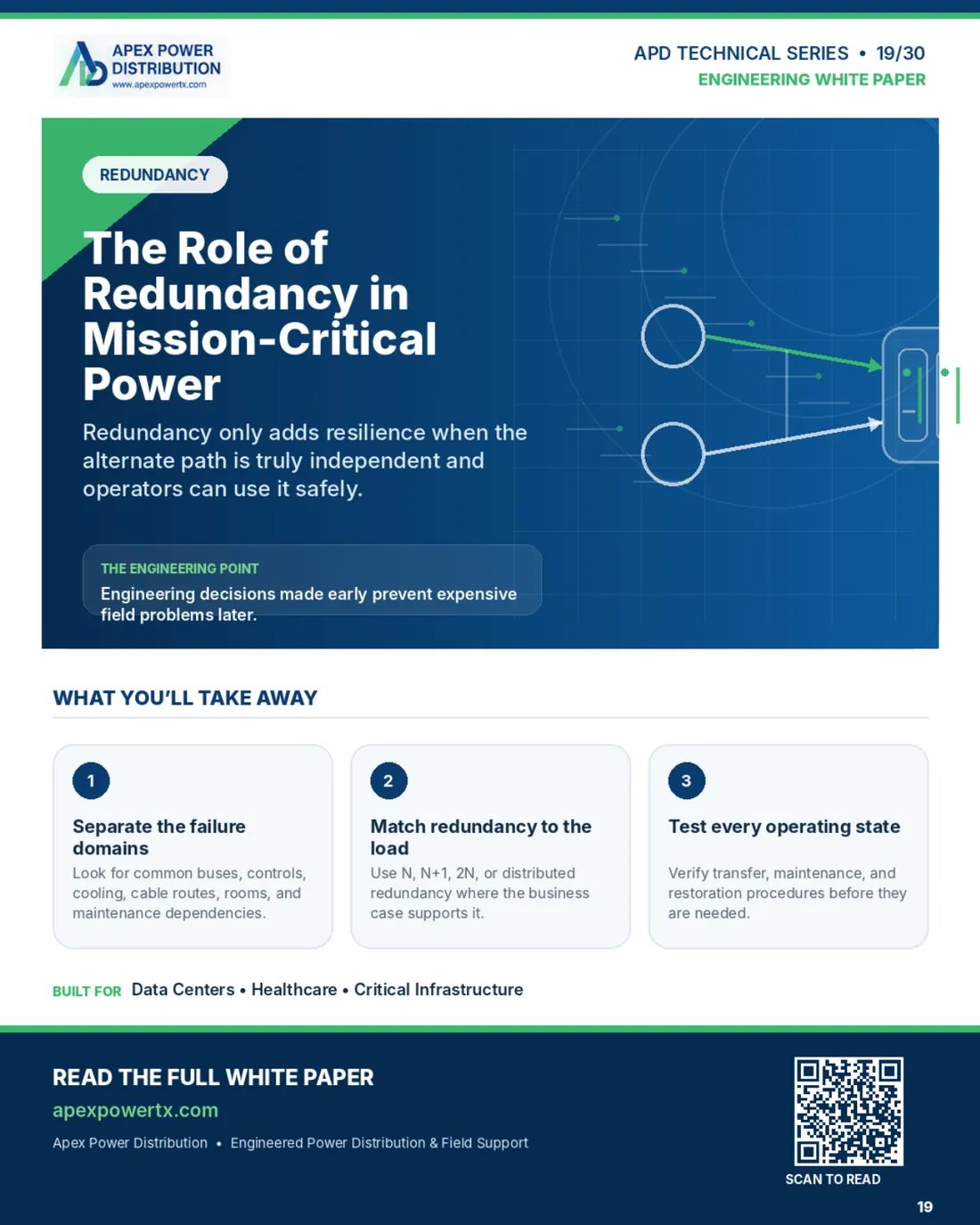
The Role of Redundancy in Mission-Critical Power
Redundancy only adds resilience when the alternate path is truly independent and operators can use it safely.
The engineering point
Engineering decisions made early prevent expensive field problems later.
What you'll take away
Separate the failure domains
Look for common buses, controls, cooling, cable routes, rooms, and maintenance dependencies.
Match redundancy to the load
Use N, N+1, 2N, or distributed redundancy where the business case supports it.
Test every operating state
Verify transfer, maintenance, and restoration procedures before they are needed.
Built for
- Data Centers
- Healthcare
- Critical Infrastructure
Go deeper
Main-Tie-Main Systems: Design and Automatic Transfer Logic
A main-tie-main lineup splits the bus so that two sources each carry part of the load and either can pick up the whole load when the other is lost. The value is in the automatic transfer logic, and this article explains how source loss is detected, how the transfer is sequenced, and which interlocks keep the scheme from doing harm.
Read the engineering articleMore in the series
Related flyers
04/30 · Mission critical
Backup Power Verification for Mission-Critical Sites
Backup power is only reliable after the entire source-to-load sequence is proven under realistic conditions.
Download PDFFor: Mission Critical Facilities · Commissioning Teams
17/30 · Industrial power
Power Distribution for High-Capacity Industrial Plants
High-capacity plants need distribution designed around large load steps, motor starting, fault duty, continuity, and growth.
Download PDFFor: Industrial Owners · EPCs