Automation & controls
Six layers. Each does one job.
Power, protection, control, communications, data and intelligence — designed so that protection never depends on the network, controls only act within engineered permissives, and analytics advise without ever operating a breaker.
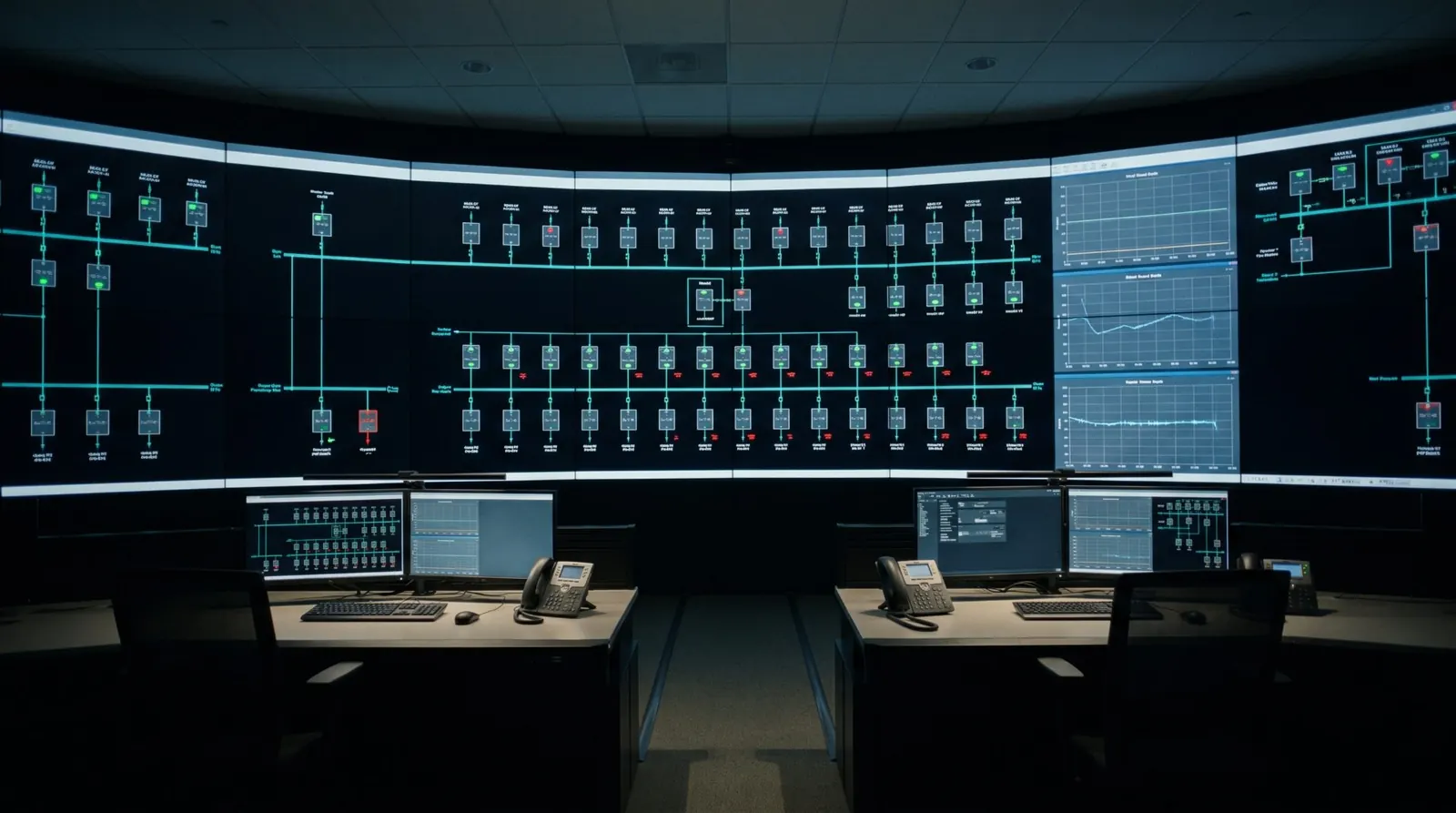
The architecture
From breaker to recommendation
Select a layer to see its elements, protocols and Apex's scope within it.
Power layer
The equipment that carries and switches current. Everything above exists to protect, operate and understand this layer.
Elements
- · Switchgear (LV and MV)
- · Switchboards
- · Circuit breakers
- · Transformers
- · Automatic transfer switches
- · Generators
- · BESS / inverter sources
- · Loads
Apex scope
Engineering, integration and modernization of the LV and MV distribution equipment; ratings, coordination and arrangement.
Control functions we engineer
Transfer, paralleling, load management, remote operation
ATS logic
Open, closed and delayed transition; source sensing, time delays, exerciser schedules, generator start/stop and BMS/SCADA reporting.
Main-tie-main logic
Two-of-three interlocking, undervoltage timers, fault-trip discrimination that blocks transfer into a faulted bus, retransfer sequences.
Generator paralleling
Sync-check, load sharing, soft load/unload, priority start, utility paralleling where permitted.
Load shedding
Priority tables and breaker-level shed/restore tied to generator capacity and transformer ratings.
Remote operation & racking
Command supervision, Local/Remote selection, logging, and motorized racking from outside the arc-flash boundary.
HMI & SCADA integration
One-lines that look like the equipment, alarm philosophy that operators can live with, tag lists that engineers can maintain.
Every control scheme is delivered with a control narrative, schematics, I/O lists and a factory acceptance test with simulated inputs, followed by a site acceptance test with the real sources present. Interlocks are never bypassed to make a test pass.
Communications
The protocols, and where each belongs
Protocol choice follows the device and the consumer of its data. Relays speak IEC 61850 or DNP3; trip units and meters speak Modbus; the enterprise wants OPC UA or MQTT. A gateway architecture reconciles them without exposing the protection network.
- Modbus RTU
- Serial RS-485 to trip units, meters and legacy devices; simple, no security — segment and gateway it.
- Modbus TCP
- Ethernet to meters, trip units, controllers and gateways; the workhorse for LV monitoring.
- DNP3
- Utility and SCADA telemetry with time-stamped events and report-by-exception; secure authentication where required.
- IEC 61850
- Station bus (MMS) for relay data and control; GOOSE for fast peer-to-peer interlocking and transfer schemes where applicable.
- OPC UA
- Interoperability layer to plant historians, MES and IT systems with built-in security model.
- MQTT
- Lightweight publish/subscribe to analytics platforms and cloud services through a secure gateway where appropriate.
Cybersecurity for digital switchgear
Connected does not have to mean exposed
Concepts we design into every connected power system, aligned with ISA/IEC 62443 zones-and-conduits thinking and IEEE 1686 device capabilities. Specific architectures, addresses and credentials are never published.
- Network segmentation & industrial DMZ
- Power SCADA on its own zone; only brokered flows cross to the corporate network.
- Role-based permissions & least privilege
- Operators operate, engineers configure, vendors get time-boxed access — nothing more.
- Secure remote access
- Jump host and MFA; no direct inbound connections to relays or controllers.
- Event logging
- Command, login and configuration events collected centrally with time sync.
- Device hardening
- Unused ports and services disabled, default credentials removed, firmware inventoried.
- Backups & patch management
- Relay settings, PLC programs and HMI projects versioned; patches tested before deployment.
- Secure gateway architecture
- Protocol conversion and data diode/one-way patterns where the risk profile calls for them.
- Authentication
- Per-user credentials on HMIs and engineering tools; protocol-level security where the protocol supports it.
Apex Power Distribution · ApexPower.ai
Let's engineer the power system —
and the intelligence around it.
Send a one-line, a specification or a photo of what is installed today. An engineer reviews it and tells you what fits — equipment, protection, controls and monitoring — before anyone talks price.